In this edition of AcademyHealth’s Situation Report, we examine the new FY26 Labor-HHS appropriations agreements and the implications they have on research funding, indirect cost caps, unlawful impoundments at AHRQ, and more. We also highlight efforts to increase the accessibility of PRAMS data, which is the cornerstone of understanding trends in maternal health and infant morbidity and mortality, as well as further efforts to undermine evidence and expertise regarding vaccines. The administration’s new health care framework also drew skepticism from both parties on Capitol Hill. While these developments signal a potential shift in terms of science and research funding as well as the value of advocacy from health services researchers, the field should continue to stay informed and educate policymakers to use evidence in decision making.
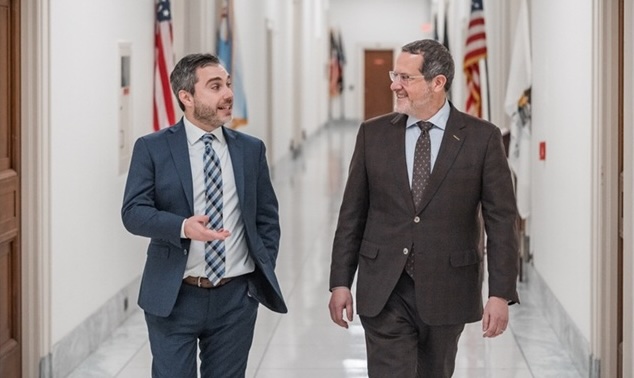
AcademyHealth in Action: AcademyHealth CEO Aaron Carroll and our Advocacy Director Josh Caplan went to the Hill this week to talk about the importance of health services research (HSR), funding AHRQ, and the role of HSR in improving care delivery during a congressional briefing hosted by Research! America.
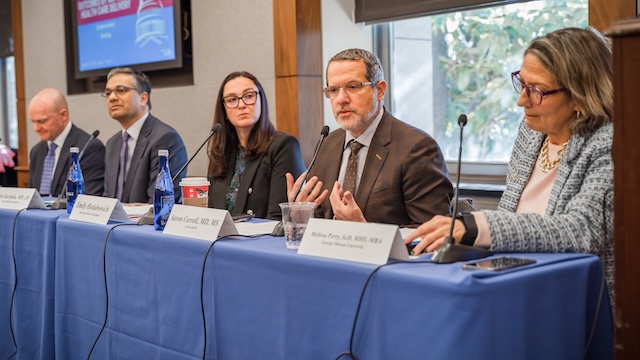
“Health services research is the instruction manual for our multi-trillion-dollar health care system. Without it, we will spend way more money than we need to. We need to make sure the people are getting what they need at a price they can afford,” Aaron Carroll said.
In this issue:
- Congress Releases FY26 HHS Funding Compromise, Shows Strong Support for AHRQ and the Research Enterprise
- AcademyHealth Advocates for PRAMS as a Critical Maternal Health Data Resource
- ‘Great Healthcare Plan’ Draws Skepticism on Capitol Hill
- Medicare Advantage Overpayments Persist Despite Reform
- Kennedy Dismantles Existing Vaccine Injury Panel, Signals Rebuild
Congress Releases FY26 HHS Funding Compromise, Shows Strong Support for AHRQ and the Research Enterprise
Following months of negotiations and in the wake of the longest government shutdown in history, congressional negotiators released final compromise FY26 Labor-HHS Appropriations language. There is a lot in it that shows the power of the health services research advocates. First, they have agreed to fund the Agency for Healthcare Research and Quality (AHRQ) at $345.38 million, a $23.6 million decrease for the Agency. It may seem counter-intuitive to celebrate a cut to AHRQ, but this number shows that Congress intends for the Agency to remain intact, independent, and with the resources to carry out its mission, which includes a robust and active extramural grant program. This legislation also includes language we advocated for that requires HHS to support necessary minimum staffing levels to fulfill statutory responsibilities and appropriations laws. Combined, this is a fundamental, bipartisan, and bicameral rejection of the illegal impoundments that have happened at the Agency, and it was only possible due to the unified advocacy of our field.
AHRQ and HHS leadership have continued the unlawful impoundments, or refusal to spend appropriated funds. Since September 30, 2025, the Agency has not released a single dollar in grant funding, as hundreds of research programs remain waiting for the funds that they were awarded. Additionally, not a single new grant has been funded since April 1. At this stage, we estimate that over 80 percent of AHRQ staff that were in place a year ago are gone and not replaced, fundamentally breaking the Agency’s ability to execute on its mission and statutory requirements. Pressure is building on the Agency to end this illegal logjam, and this appropriations agreement is a key component of that showing that both parties in Congress demand that the Agency function properly again.
In addition to the support for AHRQ, this legislation rejects other cuts throughout HHS, including providing roughly level funding for NIH, CMS, FDA, SAHMSA, ARPA-H, and HRSA. This legislation also pushed back against the Trump administration’s attempt to overhaul NIH funding dispersals, requiring that NIH cannot spend a greater dollar amount on forward-funding than it did in FY25. It also prevents NIH from capping so-called indirect costs at 15 percent.
The legislation also continues to prohibit Secretary Kennedy from unilaterally reorganizing HHS without legal authorization. In total, this legislation supports HHS being funded at $116.6 billion, a $100 million reduction from FY25 levels and $33 billion higher than President Trump’s Budget Request. This difference means significantly more research funding, more health care access for patients, and more investments in public health.
The pathway to passage seems relatively smooth at this point. Congress has until January 30th before existing budget authority runs out. The House is expected to pass the Defense, Labor-HHS, Transportation-HUD, and Homeland Security funding bills on Thursday, but this may slip until Friday. The Senate is out of session this week, and would pass either all four bills or the three without Homeland Security when they return. Once passed, Congress will have finalized FY26 funding approximately 120 days after the start of the fiscal year. Attention will then shift to FY27 with the President’s Budget Request expected to be released early February. The Friends of AHRQ, hosted by AcademyHealth, will be seeking organizational signatories on the FY27 priorities in early February as well. To join the voluntary and free Friends listserv, email us at [email protected].
AcademyHealth Advocates for PRAMS as a Critical Maternal Health Data Resource
AcademyHealth submitted comments to the Centers for Disease Control and Prevention (CDC) in support of continued federal investment in the Pregnancy Risk Assessment Monitoring System (PRAMS), which you can read here. Early last year, HHS took this dataset offline, and after we tried to work with HHS to bring it back online, we joined a lawsuit against the Department to bring it back online along with other health datasets. The administration settled the lawsuit and agreed to restore the dataset, however risks remain. The Request for Information from CDC comes at time when the current federal agreement to support the collection and dissemination of the data was set to expire in March of this year.
In our response to the CDC, we highlighted the historical background of PRAMS having been developed in 1987 in response to concerns raised over infant mortality rates. As a joint surveillance project between the CDC and state health departments, PRAMS is the cornerstone of understanding trends in maternal health and infant morbidity and mortality. These insights influence state and federal programs and policies to improve health outcomes and expand access to quality care for mothers and their infants.
‘Great Healthcare Plan’ Draws Skepticism on Capitol Hill
President Trump released a new health care framework last week calling on Congress to codify several administration initiatives, including drug pricing policies, price transparency requirements for insurers and providers, and a major shift that would redirect Affordable Care Act (ACA) subsidies into Health Savings Accounts (HSAs). The plan also promotes funding the ACA’s cost-sharing reduction program and increasing the availability of over-the-counter medicine as strategies to address rising health care costs.
Despite the administration’s calls for swift action, early congressional reception suggests that the plan will face significant hurdles. Politico reports that key provisions are unlikely to qualify under Senate reconciliation rules, limiting its ability to pass without Democratic support. Many Democrats have signaled strong opposition, while internal Republican divisions continue over whether to pursue another major health initiative ahead of the midterms. Some Republican leaders also oppose codifying the drug pricing deals, further complicating the path forward. While certain elements of the administration’s plan, such as aspects of drug price transparency, may eventually find bipartisan pathways, most of the administration’s broader proposals are unlikely to advance in the near term.
For health services researchers, this moment reinforces the importance of evidence on what actually lowers costs and improves access, particularly around subsidies, drug pricing strategies, and price transparency requirements. These topics will be central as policymakers continue to consider future health care packages, and weigh affordability options that can realistically move through Congress.
Medicare Advantage Overpayments Persist Despite Reform
Despite a 2024 CMS policy designed to limit the extent to which Medicare Advantage (MA) plans can overstate patients’ health risks to trigger higher monthly payments from CMS to MA plans, MA plans still receive significantly more money from CMS than if their patients were enrolled in traditional fee-for-service Medicare. A report from the Medicare Payment Advisory Commission (MedPAC), the entity that advises CMS on Medicare policies, gave two reasons for the trend of MA plans receiving more money in payments from CMS than traditional Medicare plans. For one, MA plans can categorize patients as having higher risk scores, which often do not predict actual services provided to patients. Additionally, the patients enrolled in MA plans tend to be healthier and thus less costly than patients in fee-for-service plans. Both of these factors cause a favorable discrepancy where MA plans receive more money from CMS than they end up needing to spend on care for their patients. This discrepancy is not as common for traditional Medicare plans. V28, CMS’s new policy, implements a payment formula that alters how patients’ risk scores are calculated. Under the new policy, payments are factored taking actual diagnoses into account, a change from the previous approach of using predictive algorithms to estimate future diagnoses. This in turn is meant to elicit more accurate payments from CMS to MA plans. Although the new policy may be starting to even out payments (MA plans are expected to receive 14 percent more than fee-for-service plans in 2026 compared to 17 percent in 2025 and 19 percent in 2024), some experts worry the plans may find loop holes in the policy that allow them to continue receiving surplus funds from CMS. These experts suggest penalizing plans that have a history of overstating their need for CMS payments as an alternate solution.
MedPAC’s new report highlights how payment design can be misaligned with real resource use. Health services researchers should continue to investigate such instances and advocate for more accurate reporting and true data when they can.
Kennedy Dismantles Existing Vaccine Injury Panel, Signals Rebuild
The future of the availability of vaccination in the United States becomes increasingly uncertain amidst HHS Secretary Robert F. Kennedy Jr.’s changes to the Vaccine Injury Panel, alarming doctors and vaccine experts. Similarly to abrupt replacements on the Advisory Committee on Immunization Practices (ACIP), Kennedy has prematurely terminated nearly half of the Advisory Commission on Childhood Vaccinations (ACCV), which advises the National Vaccine Injury Program. This program is governed by a 1986 federal law and covers vaccines recommended by federal health officials, resulting in HHS paying compensation to individuals who successfully win a petition that they have been harmed by a covered vaccine. Changing the list of advisors to this committee could result in changing the list of covered vaccines.
While Secretary Kennedy and his supporters see such changes as a positive avenue to remove vaccine protections, opponents view these changes as a threat to vaccine access. Paul Offit-- a vaccinologist and pediatrician who previously served as a vaccine adviser to the HHS-- emphasized that these actions are the most troubling to him amid all the changes under Secretary Kennedy as “we’ve been through this before.” According to Offit, failing to protect companies that manufacture vaccines from civil litigation will “destroy vaccines in this country,” noting the public health crises these actions caused in the mid-1980s.
The abrupt changes to ACIP and ACCV are part of a broader set of changes to federal vaccine advisory structures that could have significant implications for vaccine access and manufacturer participation. In doing so, these changes directly threaten public health outcomes as the availability and affordability of vaccines become increasingly inaccessible. Health services researchers can advocate for the use of evidence-based decision making to policymakers.
Previous Editions
This is the latest in a series of Situation Report updates from AcademyHealth. You can find prior issues here.
We’re pleased to offer this work as a free resource, and if you’d like to support our efforts to keep it going, we’d truly appreciate your donation. You can contribute here. Thank you for your support!