Doula Care Improves Maternal and Child Health and is Cost-Effective
Doulas are non-medical professionals who provide emotional, informational, physical, and advocacy support to people during pregnancy, labor, childbirth, and postpartum. Research from randomized controlled trials and systematic reviews has demonstrated that doulas improve maternal and child health outcomes including:
- more positive birth experiences
- reduced need for induction
- shorter labor
- lower likelihood of Cesarean delivery
- lower risk of childbirth trauma
- averting preterm birth
- higher Apgar scores
- better parent-child bonding
- better breastfeeding outcomes
- and improved postpartum mental health
By preventing negative outcomes, doulas can save an average of ~$1100 per low-risk birth, an additional ~$550 per averted Cesarean delivery, and ~$42,000 per averted preterm birth.
Many (But Not All) States Now Reimburse Doula Services Through Medicaid
Doulas are especially beneficial for pregnant people living on lower incomes and who are enrolled on Medicaid. However, Medicaid enrollees face the double bind of being at higher risk of negative perinatal health outcomes and not being able to afford private doula care. Typically, doula services cost $1,500 per birth and are paid for out-of-pocket. To address this access gap, 26 states now offer doula services to Medicaid enrollees (an additional seven states are in the process of implementing Medicaid doula benefits). Other states, particularly in the South, have unsuccessfully attempted to pass policies for Medicaid doula benefits.
The process, specific doula services covered, and reimbursement rates vary widely by state. Little research exists about 1) how these Medicaid doula policies are being implemented and 2) the experiences of doulas as they navigate the Medicaid process.
What are Doulas’ Experiences in the Reimbursement Process?
AcademyHealth is collaborating with researchers at the University of Pittsburgh to study Medicaid doula policies and processes. Project DREAM (Doula Research for equitable Advances in Medicaid Pregnancy Health) is specifically investigating the experiences of doulas, their clients, and impacts on maternal and child health equity across six states with a focus on Black, Indigenous, and people of color (BIPOC).
From December 2023 to October 2024, the team conducted 16 focus groups with 58 doulas in Maryland, Michigan, Pennsylvania, and Virginia (where there is a Medicaid doula benefit in place), in Kentucky (where one Managed Care Organization currently reimburses for doula care), and in South Carolina (where Medicaid does not currently cover any doula care). The researchers asked about doulas’ experiences with serving Medicaid clients, navigating their state’s Medicaid doula benefit process, and their recommendations for improvement.
Doulas explained that the Medicaid enrollment and reimbursement process is so cumbersome that many decide not to enroll and to only work with self-pay clients. One doula said it this way,
“...the whole Medicaid system for me is confusing...even the process of me being reimbursed...and the application and everything that they want me to do, even state certified is still a lot of hoops that I have to jump through...I just stick to, like, agencies [doula agencies]. It's a much smoother process, or if someone is able to do a private pay, I choose to go that route instead.”
The doulas re-iterated that it is especially important for Medicaid enrollees to have doula care because of the challenges they face related to housing instability, food insecurity, and transportation. One doula said,
“As doulas, it's really our job to know our community and know what resources are available...[for example] that we can provide a gas mileage voucher versus having a rideshare program...I think [it] would be extremely beneficial to support the [Medicaid] families, especially, who are dealing with a lot of different of social determinants of health.”
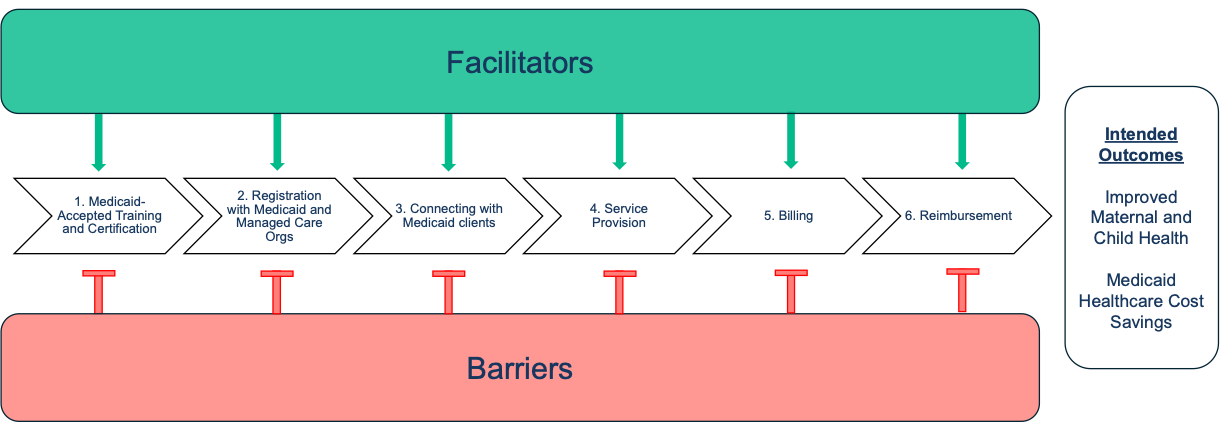
Most doulas also felt the reimbursement rates are too low (ranging from $350 to $1000 in the four states with a Medicaid doula policy) and it takes too long to be paid. The participants described the following six steps when navigating the Medicaid doula benefit process, each with their own challenges and solutions.
First, doulas must go through training programs and certification that are approved by their state’s Medicaid office. This can be expensive and doesn’t always include training programs focused on health equity, but this step can be improved through scholarships and doula involvement in the process of deciding which trainings and certifications should be acceptable.
Second, doulas must register with the state’s Medicaid office and the Managed Care Organizations. This can be quite laborious and expensive, especially when there are varying requirements across organizations, but can be facilitated when doulas receive training and guidance about how to register.
The third step is actually connecting with Medicaid clients, which can be challenging because of low public awareness about doulas and healthcare provider against doulas. But client connection is facilitated when Medicaid makes enrollees aware of the benefit (along with a directory) and when providers refer their patients to doulas.
The fourth step is service provision, wherein doulas go “above and beyond” for Medicaid patients, but doulas must navigate exclusionary hospital policies, discrimination by healthcare providers, and inadequate Medicaid coverage (ex: number of visits, length of visits) to meet the complex needs of Medicaid enrollees.
The fifth step is billing, which can be very challenging for individual doulas who are not familiar with the process and who face technical difficulties with the online Medicaid interface. Training and billing support from doula collectives or companies who manage billing can significantly improve this process.
The final step is actual reimbursement, which can be quite delayed and inadequate to provide a living wage for full-time doulas. Involving doulas in the policymaking when setting reimbursement rates can facilitate better reimbursement experiences for doulas.
Doulas’ Recommendations
Finally, doulas offered several recommendations to improve the Medicaid doula benefit process to reduce the burden on doulas and improve access and quality of services for Medicaid enrollees. First, they said policymakers should involve doulas in all stages of policy development and evaluation. Doulas also want to educate policymakers about the benefits and scope of doula care services, to clearly identify existing or potential challenges Medicaid doulas face, and to uplift solutions that have worked in successful states and implement scholarships, training, and mentorship. Finally, doulas emphasized that Medicaid clients should be provided insurance coverage for holistic perinatal care including midwifery, access to birth centers and home birth, lactation support, and transportation.
Read the full publication here.