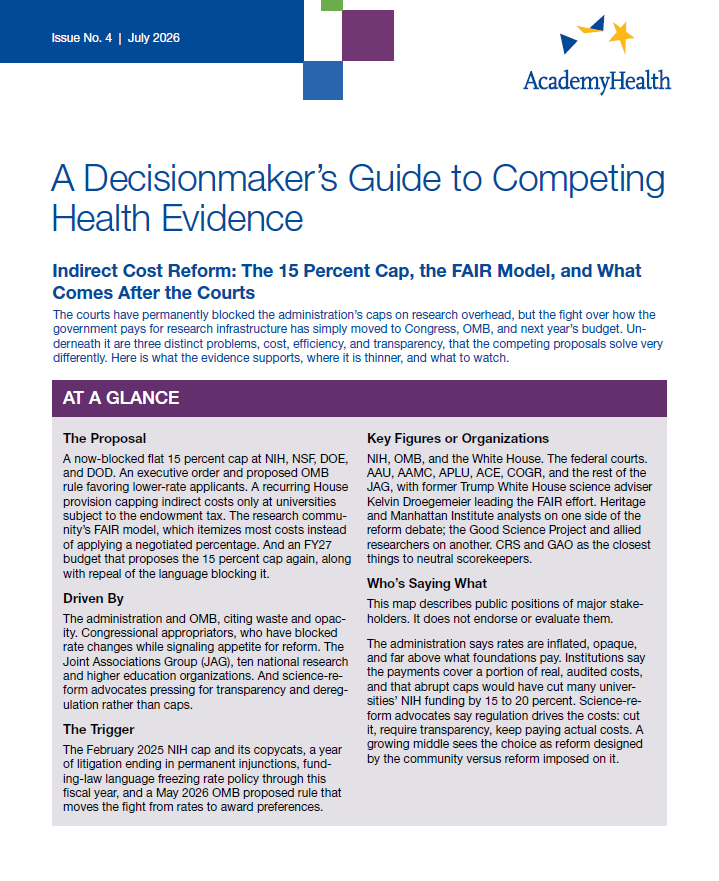
A Decisionmaker's Guide to Competing Health Evidence: Indirect Cost Reform: The 15 Percent Cap, the FAIR Model, and What Comes After the Courts
The fourth edition of AcademyHealth's monthly series examines the growing debate over indirect cost reimbursement in federally funded research. It explains why stakeholders are often talking about fundamentally different problems, what the evidence shows about research infrastructure costs and transparency, and how decisionmakers can evaluate competing reform proposals, including the administration's cap and preference policies and the research community's FAIR model.
The fight over indirect research costs is often presented as a simple dispute about administrative overhead. In reality, it is a debate about how the federal government pays for the infrastructure that makes research possible, and whether anyone can clearly explain the bill.
In 2025, the administration attempted to replace institutions' negotiated indirect cost rates with a flat 15 percent cap, arguing that federal reimbursements had become too costly and opaque. Universities, academic medical centers, hospitals, and research institutes responded that the proposed cuts would remove billions of dollars that support laboratories, data systems, compliance programs, and research facilities. Federal courts ultimately blocked the policy, but the underlying questions remain unresolved.
This guide explains why stakeholders are often talking past one another. Some are focused on what research infrastructure actually costs. Others are concerned with whether the current reimbursement system encourages efficiency. Still others argue that the biggest problem is transparency, that neither policymakers nor taxpayers can easily see where the money goes.
What is covered
- Why the indirect cost debate is really three separate debates about cost, efficiency, and transparency
- What the evidence shows about negotiated rates, research infrastructure spending, and the likely impact of proposed funding caps
- How the administration's 15 percent cap, OMB's proposed award preference policy, and the research community's FAIR model would change the system
- What remains unknown, including the efficiency question that virtually every reform proposal claims to address
What the evidence shows
The strongest evidence in this debate supports two conclusions. First, indirect costs fund real and substantial infrastructure expenses that support federally funded research. Second, the current system is opaque enough that even many institutions defending it acknowledge the need for greater transparency.
What remains uncertain is whether the federal government is paying more than an efficient system would require. Critics argue that negotiated rates may weaken incentives to control costs over time. Defenders counter that rates simply reflect audited expenses necessary to conduct research. Even after years of debate, there is little direct evidence that can resolve this question.
As a result, policymakers are increasingly choosing among competing theories rather than competing facts. The administration's 15 percent cap, OMB's proposed preference for lower-rate applicants, and the research community's FAIR model each attempt to solve a different version of the problem. Understanding which problem a proposal is trying to solve is often more important than understanding what percentage appears in the headline.
This guide helps decisionmakers separate established evidence from projections, identify where the data are strongest, and evaluate competing reform proposals as Congress, federal agencies, and the research community shape the next phase of indirect cost policy.
About this series
A Decisionmaker's Guide to Competing Health Evidence is a monthly series from AcademyHealth. Each edition takes a live policy debate, explains the structure of the disagreement, and gives readers the tools to evaluate the evidence themselves. Please note, each edition reflects the evidence as it existed at the time of publication. Factual corrections submitted within 30 days of publication will be reviewed and, where warranted, incorporated with a clear notation of what changed and why.