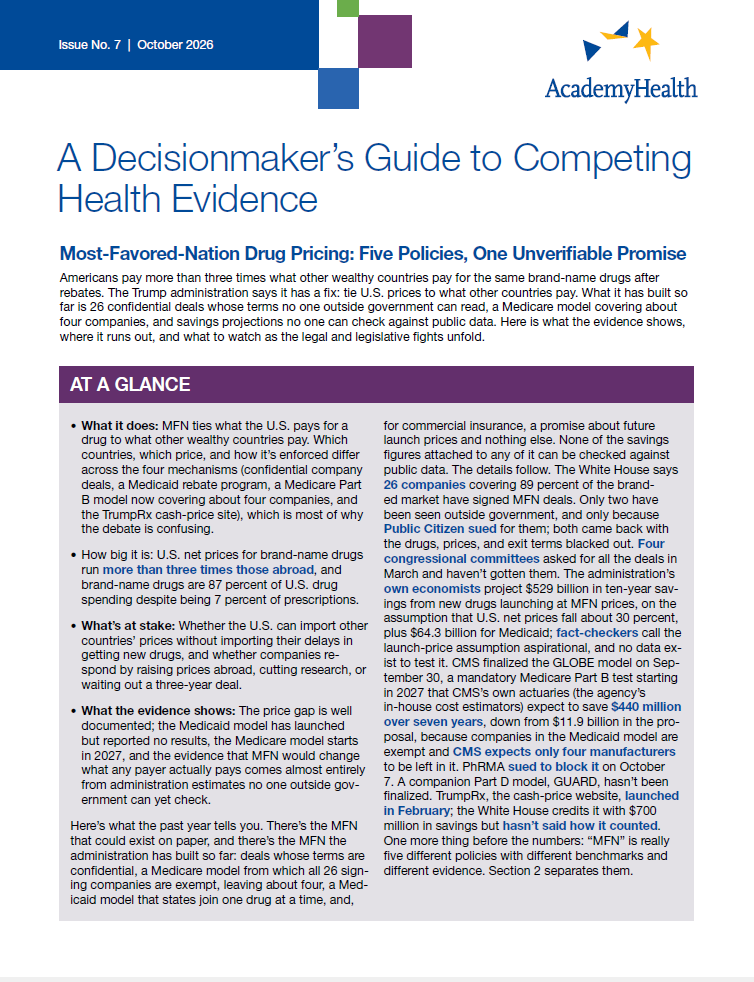
A Decisionmaker's Guide to Competing Health Evidence: Most-Favored-Nation Drug Pricing: Five Policies, One Unverifiable Promise
The seventh edition of AcademyHealth's monthly series examines most-favored-nation drug pricing, explaining why five different policies are being called by the same name, what the evidence actually shows about the price gap between the U.S. and other countries, and what decisionmakers should watch as the legal and legislative fights unfold.
Americans pay more for brand-name drugs than anyone else. That's not a partisan claim. It has held up across twenty years of studies, and the best current estimate puts U.S. net prices at more than three times what other wealthy countries pay for the same drugs.
Most-favored-nation pricing is one proposed answer: tie what the U.S. pays to what other countries pay, and the gap closes. What has actually been built is more complicated. There are 26 confidential company deals whose terms no one outside government can read, a Medicare model that covers about four companies after most of the industry was exempted, a Medicaid program that has launched but reported nothing publicly measurable, and savings projections that rest on assumptions no one can check against public data.
This guide does not take a side on whether MFN is the right policy. It explains what the evidence shows, what it doesn't, and how to read any MFN claim you encounter.
What is covered
Why five different policies are being called by the same name, and why that's the source of most of the confusion
What the evidence shows on the U.S.-to-other-countries price gap, and what it can't tell us about whether these specific policies close it
What the deals have actually delivered so far, and what the savings projections assume
What to watch: the PhRMA lawsuit, the January 2029 deal expiration, and what happens if Congress tries to write this into law
How to evaluate any MFN claim you encounter, including which number is a measurement and which is a projection
What the evidence settles
The price gap is real and well-documented, concentrated in brand-name drugs without competition. Reference pricing can delay drug launches in the countries being referenced, especially lower-priced ones, and early reports suggest that may already be starting in Europe. IRA negotiation produced real but modest net savings, with prices still far above what a true MFN policy would require.
What the evidence does not settle is whether the current deals are changing what any American actually pays. The deals are confidential. The Medicaid model has reported nothing. The Medicare model hasn't started. The $529 billion savings projection rests on launch-price assumptions no one can test against public data.
About this series
A Decisionmaker's Guide to Competing Health Evidence is a monthly series from AcademyHealth. Each edition takes a live policy debate, explains the structure of the disagreement, and gives readers the tools to evaluate the evidence themselves. Each edition reflects the evidence as it existed at the time of publication. Factual corrections submitted within 30 days of publication will be reviewed and, where warranted, incorporated with a clear notation of what changed and why.