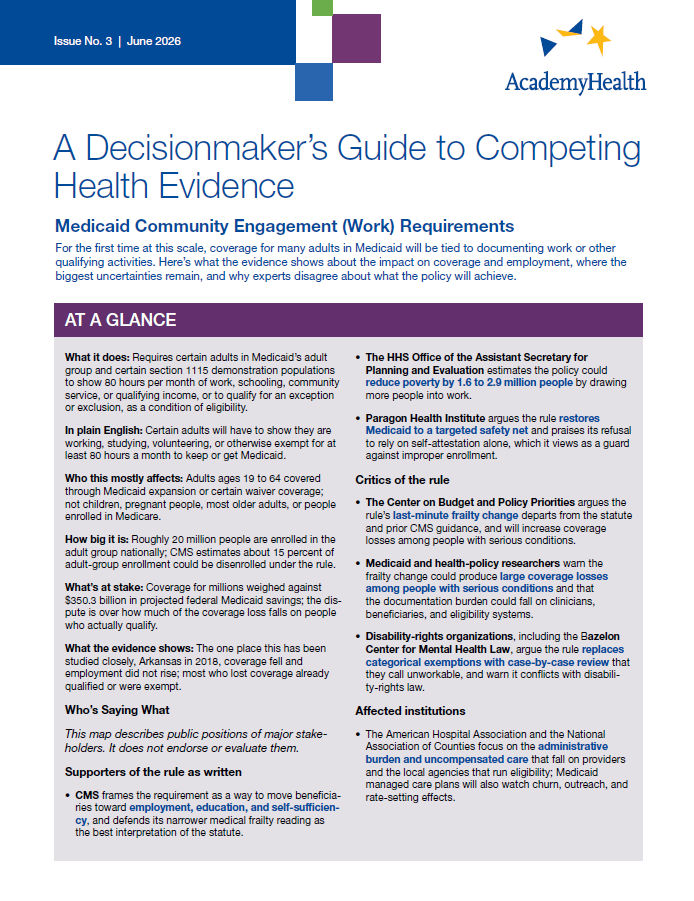
A Decisionmaker's Guide to Competing Health Evidence: Medicaid Community Engagement (Work) Requirements
The third edition of AcademyHealth's monthly series examines Medicaid work requirements, explaining what happened in the one major real-world test, why supporters and critics are often answering different questions, and what decisionmakers should watch as states begin implementation.
The debate over Medicaid work requirements often sounds like a debate about values. The evidence suggests it is largely a debate about mechanisms.
Supporters view the policy as a way to encourage employment, self-sufficiency, and program integrity. Critics worry it will primarily function as a documentation requirement that removes coverage from people who are already working, already qualify for exemptions, or struggle to navigate administrative processes.
This guide does not take a side. It maps the evidence and gives readers the tools to evaluate competing claims.
What is covered
• What the new federal Medicaid work requirement does and who it affects
• What happened in Arkansas, the most closely studied real-world example
• What the evidence shows about coverage loss and employment outcomes
• Why the medical frailty exemption has become a central point of disagreement
• What states, providers, and policymakers should watch during implementation
What the evidence shows
The strongest evidence comes from Arkansas, where Medicaid coverage fell substantially after implementation while employment did not increase. Researchers found that most people who lost coverage already met the requirement or qualified for an exemption, but failed to navigate reporting and verification requirements. CMS's own projections similarly attribute a significant share of expected coverage losses to administrative barriers rather than noncompliance.
The evidence on employment is much less certain. Supporters point to projections and evidence from welfare-to-work programs, while studies of actual Medicaid work requirements have not found increases in employment.
About this series
A Decisionmaker's Guide to Competing Health Evidence is a monthly series from AcademyHealth. Each edition takes a live policy debate, explains the structure of the disagreement, and gives readers the tools to evaluate the evidence themselves.