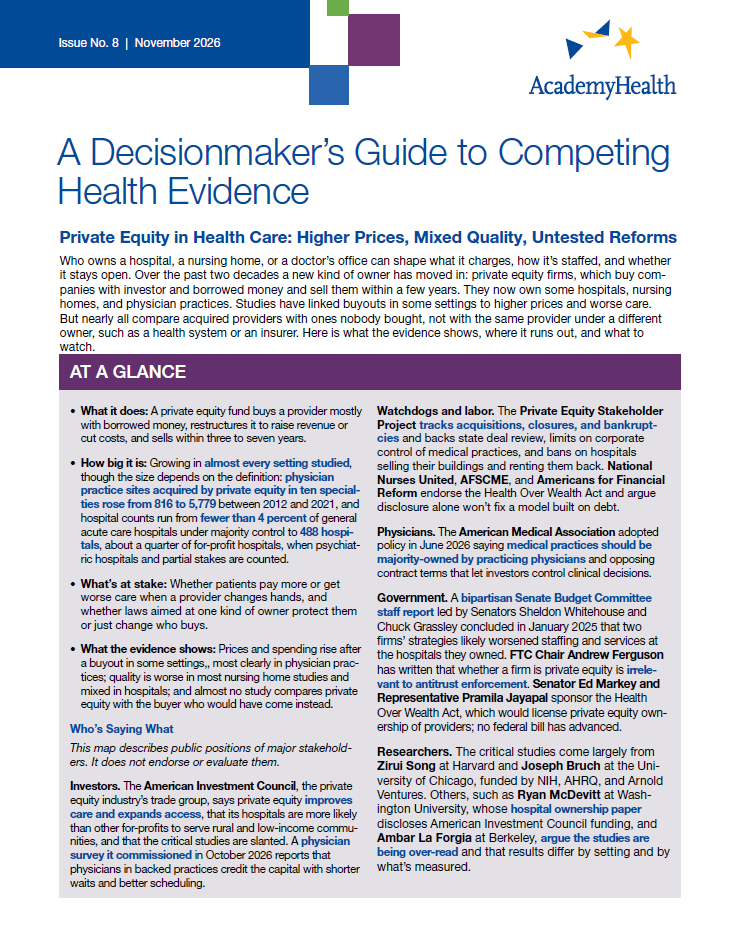
A Decisionmaker's Guide to Competing Health Evidence: Private Equity in Health Care: Higher Prices, Mixed Quality, Untested Reforms
The eighth edition of AcademyHealth's monthly series examines the evidence on private equity ownership of hospitals, nursing homes, and physician practices, explaining why nearly every study compares acquired providers with ones nobody bought and what that means for the state laws now being written.
Who owns a hospital, a nursing home, or a doctor's office can shape what it charges, how it is staffed, and whether it stays open. Over the past two decades, a growing kind of owner has moved in: private equity firms, which buy companies with investor and borrowed money and sell them within a few years. The number of physician practice sites they own in ten specialties rose from 816 to 5,779 between 2012 and 2021.
The research on what happens after a buyout now shapes legislation. Sixteen states require notice of large health care deals, and some can block them. But nearly all of the studies compare an acquired provider with one nobody bought. That tells you whether things changed after the buyout. It doesn't tell you whether a health system or an insurer would have done better with the same provider, which is the choice a state review board faces.
This guide does not take a side on whether private equity belongs in health care. It explains what the evidence shows, setting by setting, and where it runs out.
What the guide covers
The guide explains why "private equity in health care" means at least four different things, what the studies find on prices, quality, and closures, what to watch as states and Congress write new rules, and five questions you can use to evaluate any claim you hear.
What the evidence shows
Prices rise most clearly at acquired physician practices. The strongest evidence of worse care is in nursing homes. In hospitals, the studies disagree, and the disagreement mostly comes down to what each one measures. Acquired hospitals closed no more often than comparable hospitals, though well-known closures complicate that picture.
What the evidence can't settle is whether any of this is specific to private equity, or is what happens when any owner buys with borrowed money and plans to sell. And not one of the notice or approval laws now in place has been evaluated.
About this series
A Decisionmaker's Guide to Competing Health Evidence is a monthly series from AcademyHealth. Each edition takes a live policy debate, explains the structure of the disagreement, and gives readers the tools to evaluate the evidence themselves. Please note, each edition reflects the evidence as it existed at the time of publication. Factual corrections submitted within 30 days of publication will be reviewed and, where warranted, incorporated with a clear notation of what changed and why. academyhealth.org/about/programs/decisionmakers-guide-competing-health-evidence
Support this work
Guides like this one are independent and take no sides. Individual donations help make them possible. Consider making a donation here.