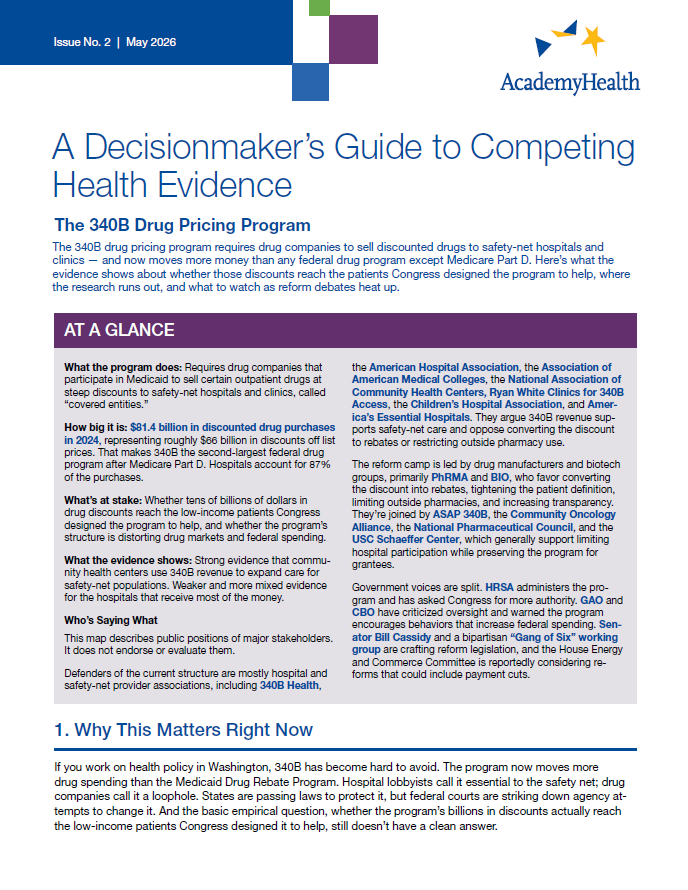
A Decisionmaker's Guide to Competing Health Evidence: The 340B Drug Pricing Program
The second edition of AcademyHealth's monthly series examines the 340B drug pricing program, explaining why the evidence looks so different depending on which type of provider you are asking about, and giving decisionmakers the tools to evaluate competing reform claims.
If you have tried to follow the 340B debate in Washington, you have probably noticed that smart, credible people are citing very different evidence and reaching very different conclusions. Hospital groups call the program essential to the safety net. Drug companies call it a loophole. Government watchdogs say it is increasing federal spending. And researchers who have studied it for a decade say the answer depends entirely on which question you are asking.
This guide does not take a side. It maps the debate -- and gives you the tools to evaluate the claims yourself.
What’s covered
- Why the evidence on 340B looks so different depending on which type of provider you are studying
- What the research actually shows about hospitals, community health centers, biosimilar use, and program growth
- What could go wrong under different reform scenarios -- and what to watch for
- How to evaluate the studies and claims you will encounter as the reform debate unfolds
What the evidence shows
The strongest finding from a decade of 340B research is that the program works very differently for different types of providers. Community health centers show strong evidence of using 340B revenue to expand care for low-income, uninsured, and underserved patients. The evidence for hospitals is much more mixed. Studies find that 340B eligibility is associated with hospitals acquiring physician practices, reducing biosimilar use, and generating revenue that does not clearly flow to low-income patients.
Reform proposals that treat the program as a single thing are likely to misfire. The evidence points to a program that is working as intended in some places and producing unintended effects in others.
About this series
A Decisionmaker's Guide to Competing Health Evidence is a monthly series from AcademyHealth. Each edition takes a live policy debate, explains the structure of the disagreement, and gives readers the tools to evaluate the evidence themselves. Please note, each edition reflects the evidence as it existed at the time of publication. Factual corrections submitted within 30 days of publication will be reviewed and, where warranted, incorporated with a clear notation of what changed and why.