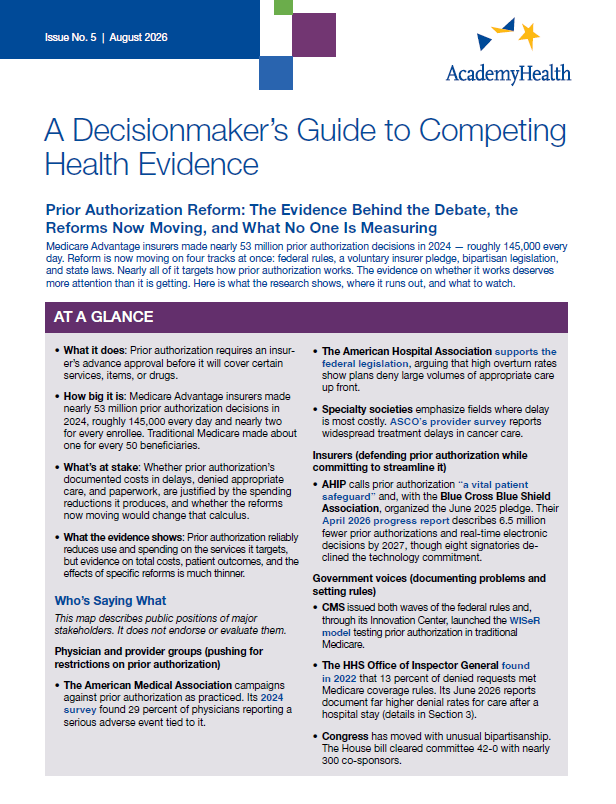
A Decisionmaker's Guide to Competing Health Evidence: Prior Authorization Reform
The latest edition of AcademyHealth's monthly series examines the evidence behind the debate over prior authorization, what research shows about its effects on spending and care, and what remains unknown as major reforms take effect.
Prior authorization is designed to manage health care use and spending, but its benefits and costs are distributed across different parts of the health care system. Insurers may capture savings, while physicians and patients can bear administrative burdens and the consequences of delays or denials. As federal and state policymakers move to reform the process, the evidence behind those tradeoffs deserves a closer look.
The research provides some clear answers, but important gaps remain, particularly around care that is deterred before a request is submitted and the broader effects of prior authorization.
What is covered
- How prior authorization works and why it has become such a major policy issue
- What the strongest evidence shows about its effects on health care spending and utilization
- What research and government audits reveal about denials, delays, and appeals
- Why experts disagree about the costs and benefits of prior authorization
- Five questions decisionmakers can use to evaluate claims about prior authorization
What the evidence shows
The strongest research shows that prior authorization reduces use and spending on the services it targets, particularly when applied to narrowly defined services with documented overuse. But we know much less about whether it reduces total health care spending once substitute care, downstream costs, administrative burden, and foregone care are counted.
Some prior authorization denials also involve care that meets Medicare's own coverage rules. An HHS Office of Inspector General audit found that 13 percent of Medicare Advantage denials it reviewed met Medicare coverage rules, while 80.7 percent of appealed denials were overturned. Yet only about one in nine denials is appealed, leaving many denials that may have been inappropriate without further review.
Meanwhile, there is little rigorous research on the reforms now moving. Federal timeline requirements, electronic submission, gold carding, and voluntary insurer pledges have not yet been shown to improve outcomes or reduce the burdens associated with prior authorization. The bottom line: Prior authorization can save money, but we know much less about the care that is deterred and whether the reforms now underway will improve outcomes, reduce burden, or change that tradeoff.
About this series
A Decisionmaker's Guide to Competing Health Evidence is a monthly series from AcademyHealth. Each edition takes a live policy debate, explains the structure of the disagreement, and gives readers the tools to evaluate the evidence themselves.