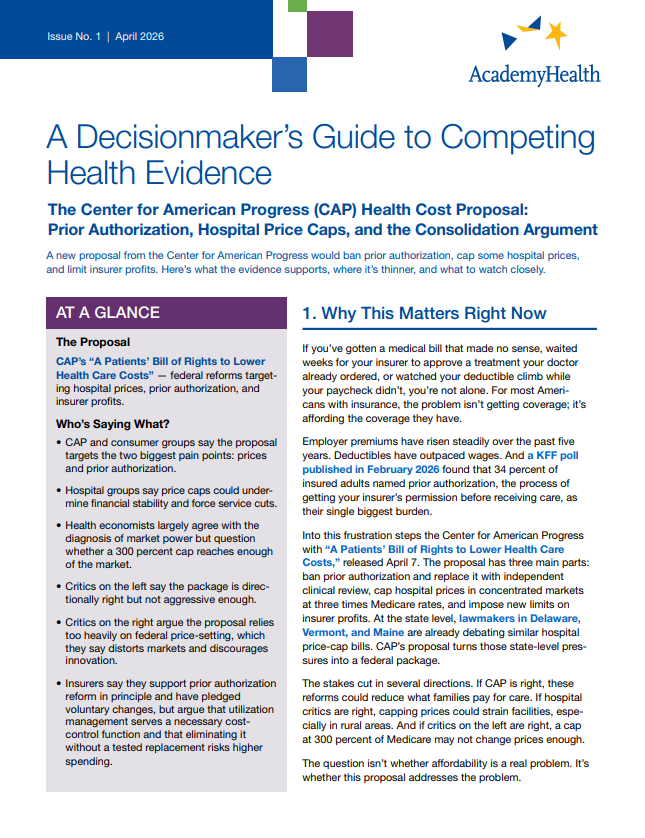
A Decisionmaker's Guide to Competing Health Evidence: The CAP Health Cost Proposal — Prior Authorization, Hospital Price Caps, and the Consolidation Argument
This first edition of AcademyHealth's new monthly series examines the Center for American Progress's "Patients' Bill of Rights to Lower Health Care Costs," breaking down what the evidence supports on prior authorization reform, hospital price caps, and market consolidation and where key questions remain unsettled. Updated April 28 to reflect additional detail on the proposal's growth cap provision, composite cap structure, and prior authorization reform design.
Most Americans with insurance aren't worried about losing their coverage. They're worried about using it. Premiums keep rising. Deductibles outpace wages. And for the 34 percent of insured adults who've struggled with prior authorization, the system feels designed to say no.
The Center for American Progress has a proposal to change that. Its April 2026 "Patients' Bill of Rights" would ban prior authorization, cap hospital prices in concentrated markets, and limit insurer profits. It's a significant federal intervention — and it's landing in the middle of a genuine evidence debate.
This guide doesn't take a side. It maps the debate.
What's covered
Why experts who cite different evidence on this topic aren't necessarily contradicting each other
What the research actually shows on prior authorization reform, hospital price caps, and consolidation
What might break — and what remains genuinely unknown
How to evaluate the studies and claims you'll encounter as this debate unfolds
What the evidence shows
The case for prior authorization reform is well-supported. The AMA found 93 percent of physicians say it delays necessary care. The AHA reports hospitals spent $43 billion in 2025 just pursuing insurer payment. The harder question is whether CAP's proposed replacement model has been tested enough to work at scale.
On hospital prices, Oregon's real-world experience with a price cap is encouraging — but Oregon capped prices at 200 percent of Medicare rates, and CAP proposes 300 percent. That gap matters. The evidence on consolidation is among the strongest in health services research: market concentration raises prices, and quality rarely improves. But price caps address the symptom, not the underlying market structure.
About this series
A Decisionmaker's Guide to Competing Health Evidence is a monthly series from AcademyHealth. Each edition takes a live policy debate, explains the structure of the disagreement, and gives readers the tools to evaluate the evidence themselves. Please note, each edition reflects the evidence as it existed at the time of publication. Factual corrections submitted within 30 days of publication will be reviewed and, where warranted, incorporated with a clear notation of what changed and why.