For patients facing uncertainty or fear around a cancer diagnosis, cancer biomarker testing holds the potential to transform their cancer care experience and outcomes. It can connect patients with treatments most likely to benefit them, spare them from less effective, costly therapies, and empower them to make informed choices about treatment with their providers. On a population level, biomarker testing improves cancer survival and reduces unnecessary health care spending. Despite this, fewer than half of eligible cancer patients currently receive the biomarker testing they should. When testing does occur, it is often applied inconsistently across care settings, geographies, and populations due to unclear payment pathways, poorly defined roles in testing, disorganized testing workflows, and unstructured systems for storing and sharing data. While organizations across the health care ecosystem have made real efforts to overcome these barriers, bringing cancer biomarker testing to scale will require cross-sector collaboration to align priorities, incentives, and progress.
In recognition of this need, AcademyHealth convened 35 leaders across the cancer care ecosystem in December of 2025 to launch the Innovation Adoption Center (IAC) Scaling Cancer Biomarker Testing Coalition and establish a shared vision: a cancer care system where biomarker testing is standardized and equitable, with providers, patients, payers, health systems, policymakers, and industry all working together for the best possible outcomes for cancer patients. The resulting Scaling Cancer Biomarker Testing Strategic Roadmap for Collective Action presents a framework for coordinated action to set the coalition on this shared path.
The Roadmap: A Collective Impact Approach to Transform the Cancer Care Journey
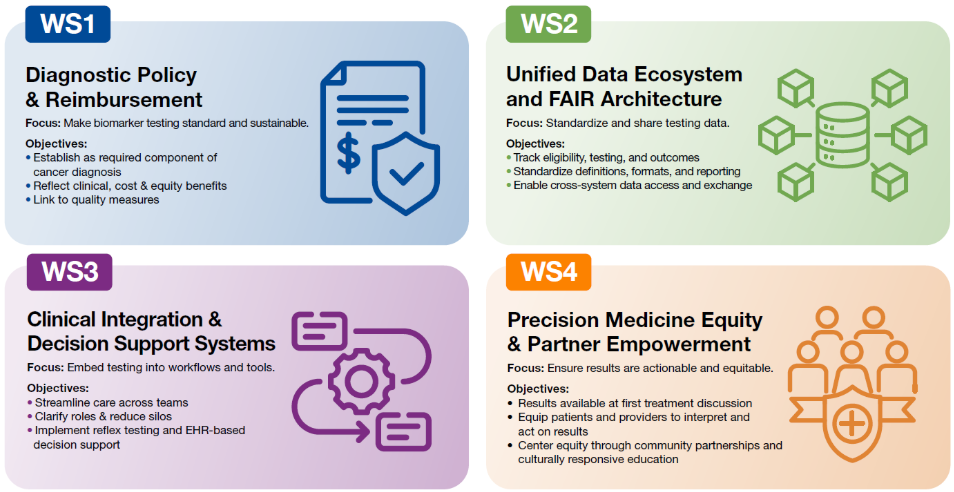
To bring the coalition’s vision to life, the roadmap presents four interdependent workstreams, each addressing a distinct barrier to achieving equitable cancer biomarker testing at scale. For each workstream, the roadmap lays out specific, actionable ways to push progress forward. Informed by a collective impact approach, the workstreams pair policy change with input from on-the-ground clinical champions and engagement from the community, ensuring that national efforts reflect what patients and care teams actually experience.
- Workstream 1. Diagnostic Policy & Reimbursement
- The Barriers: No universal standards for appropriate testing, unclear payment pathways to cover testing, and lack of quality measures for accountability.
- Workstream Opportunity: Align coverage, payment, and quality expectations across diagnostic and treatment pathways to incentivize, rather than discourage, evidence-based biomarker testing.
- Workstream 2. Unified Data Ecosystem & FAIR Architecture
- The Barriers: Inconsistent data capture and storage; unclear data sharing and use policies.
- Workstream Opportunity: Create a data infrastructure that makes biomarker testing information findable, accessible, interoperable, and actionable across the cancer care continuum.
- Workstream 3. Clinical Integration & Decision Support Systems
- The Barriers: Unorganized testing workflows; unclear roles for clinicians and laboratory staff.
- Workstream Opportunity: Embed biomarker testing seamlessly into routine cancer care by aligning clinical, laboratory, and pathology workflows across the care continuum.
- Workstream 4. Precision Medicine Equity & Partner Empowerment
- The Barriers: Providers unprepared to interpret, deliver, and act on test results; limited patient literacy around biomarker testing.
- Workstream Opportunity: Ensure biomarker test results are available and meaningfully used at the first treatment discussion, and equip patients and providers with the knowledge, tools, and support needed to interpret and act on results.
The roadmap also defines six shared measures of success that illustrate what fully optimized, patient-centered biomarker testing would look like. These indicators serve as north stars to help the coalition assess if workstream activities are achieving their intended goals.
- A: Consistent, Actionable Testing – Eligible patients are tested and results inform treatment decisions.
- B: Integrated Workflows & Reimbursement – Testing is embedded in diagnostic and payment systems.
- C: Unified, Standards-Based Data – Testing data are findable, accessible, interoperable, and reusable.
- D: Equipped Patients, Prepared Providers – Patients and providers have the knowledge, trust, and support to apply results.
- E: Shared Value Proposition – Stakeholders align on clinical, economic, and societal ROI.
- F: Sustained System Change – Incentives, policies, and decision support make concordant testing the default.
Together, the roadmap’s components provide a common framework for coalition members to align efforts, identify opportunities for action, and achieve and track meaningful progress toward a cancer care ecosystem in which biomarker testing occurs consistently, efficiently, and equitably at a national scale.
Viewing the Roadmap
The full Scaling Cancer Biomarker Testing Strategic Roadmap for Collective Action is available here. A companion Roadmap Brief providing a condensed version of this framework is forthcoming. Supporting context on the current state of biomarker testing and the barriers to widespread adoption is provided in Appendix D of the full roadmap.
To learn more, contribute to a workstream, or join the Scaling Cancer Biomarker Testing Coalition, contact [email protected].
About The Coalition
The Innovation Adoption Center (IAC) Scaling Cancer Biomarker Testing Coalition is convened by AcademyHealth with support from Pfizer, Eli Lilly, and Johnson & Johnson Innovative Medicine. The coalition emerged from a Design Meeting held December 13-14, 2025, which brought together leaders representing clinical practice, pathology, patient advocacy, health system transformation, implementation science, industry, and policy. Our vision is a transformed cancer care system in which guideline-concordant biomarker testing is a regular part of cancer care and supported by a high-trust alliance of patients, providers, payers, policymakers, researchers, and industry partners that understand the value of precision medicine.