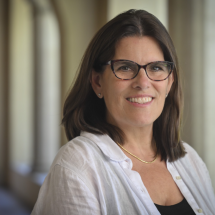
Sara J. Singer, M.B.A., Ph.D., is a Professor of Health Policy and Medicine at the Stanford University School of Medicine; Professor of Organizational Behavior, by courtesy, at the Stanford Graduate School of Business; and Senior Fellow, by courtesy, at the Freeman Spogli Institute for International Studies. She is the Faculty Director and Director of Research of Stanford’s Distinguished Careers Institute. She also serves as Associate Director of the Clinical Excellence Research Center in the Department of Medicine and as Faculty Director of the Health Leadership, Innovation, and Organizations (HELIO) Labs in the Division of Primary Care and Population Health. She is affiliated faculty with Stanford’s Center for Innovation in Global Health, Woods Institute for the Environment, and Center for Artificial Intelligence in Medicine & Imaging.
Dr. Singer studies team, organization, and system design and dynamics to understand how leaders, innovators, and policymakers can improve health delivery and population health. Her research program addresses central challenges in health delivery (ensuring patient safety despite complexity and uncertainty; integrating fragmented services; implementing, adapting, and sustaining innovations that enhance value; and promoting a culture of health), where her research suggests that learning- and systems-oriented leaders and teams and supportive organizational cultures are critical factors for creating high performing delivery systems and collaborations. Her intellectual contributions include developing theoretical frameworks, interventions, valid and reliable data collection instruments, and evidence-bases for safety climate, organizational learning, integrated patient care, and culture of health.
Dr. Singer currently directs research programs, including a National Science Foundation program on the “Future of Technology-Enabled Work” in health care (2020-present), a NIH project to enhance Teaming for the “AI Ready and Exploratory Atlas for Diabetes Insights (AI-READI)” (2022-present), a National Institute for Minority Health and Health Disparities project to “Implement Scalable, PAtient-centered, Team-based, Technology-Enabled Care for Adults with Type 2 Diabetes” (iPATH) (2023-present). She is subaward PI for a National Cancer Institute project, “Understanding Integration in Oncology Care and Association with Quality and Outcomes”. She served as a member of the National Academy of Science, Engineering, and Medicine Committee on Transforming Health Care to Create Whole Health: Strategies to Assess, Scale, and Spread the Whole Person Approach to Health and of the Lancet Commission Project on Transformative Research to Scale Mental Health Interventions. Dr. Singer chairs the Stanford University Faculty Women’s Forum Steering Committee and the Department of Health Policy’s PhD Admissions Committee; serves as a member of Stanford University’s Faculty Senate, Committee on Faculty Staff Human Resources, Committee on Health and Safety, Task Force for Research Practice and Culture, and Human-Centered Artificial Intelligence Institute’s Healthcare AI Policy Steering Committee; and as Faculty Advisor for Stanford’s Solar Car Project. She was the inaugural chair of the Advisory Committee of the Senior Academy at Stanford Medicine. She also serves on the Board of the Harvard Medical Faculty Physicians and is an Adjunct Professor at Harvard Chan School of Public Health.
Previously, Dr. Singer was Professor of Health Care Management and Policy at the Harvard T. H. Chan School of Public Health and the Department of Medicine at Harvard Medical School in the Mongan Institute for Health Policy, Massachusetts General Hospital. She acted as Director of Graduate Studies of the Harvard PhD in Health Policy Program (2016-2017) and Co-Chair of the Health Policy PhD Program’s Management Track (2013-2017), Director of the Healthcare Management Field of Study for the Masters in Public Health Program at the Harvard Chan School (2015-2017), and Member of the University Benefits
Committee (2012-2017). She also served for five-years as a leader of the Academy of Management Health Care Management Division, completing her term as Past Chair in 2022, and as Chair of the Organization Theory in Health Care Association 2022-2023.
Dr. Singer has conducted numerous studies for the Agency for Healthcare Research and Quality, Veterans Administration Health Services Research & Development, National Science Foundation, National Institutes of Health, Patient-Centered Outcomes Research Institute, National Academy of Medicine, and private foundations related to measuring and improving organizational culture, learning, teamwork, patient safety, care delivery innovation, integrated patient care, culture of health, and the financing and delivery of health care. She served as Principal Investigator for the AHRQ-funded Engineering High Reliability Learning Lab (2015-2022) and the Robert Wood Johnson Foundation-sponsored program to promote a Culture of Health as a Business Imperative (2017-2023); Implementation Research Director for the Safe Surgery 2015 initiative (2010-2017), Evaluation Co-Chair for Massachusetts’ Proactive Reduction in Outpatient Malpractice: Improving Safety Efficiency and Satisfaction (PROMISES) program (2010-2014), Evaluation Team Member for the Academic Innovations Collaborative / Comprehensive, Accessible, Reliable, Exceptional and Safe (AIC / CARES) Collaborative (2012-2016), and Founder and Director of the National Patient Safety Consortium (1999-2003). She also co-founded and served as Executive Director for the Center for Health Policy at Stanford (now Stanford Department of Health Policy), where she was a Senior Research Scholar and Lecturer (1993-2003). Dr. Singer served as Staff Director for the California Managed Care Improvement Task Force (1997-98), a Senior Legislative Assistant for Health Policy in the US House of Representative (1994), and Health Policy Analyst at the Office of Management and Budget (1992).
Dr. Singer has published more than 300 articles in academic journals and books on healthcare management, health policy, and health system reform. Her publications have won numerous awards, including Article of the Year 2022 from Medical Care Research and Review; best paper awards from the Academy of Management’s Health Care Division in 2009, 2010, 2011, 2019, two in 2023, and 2025; and from the Production and Operations Management Society College of Service Operations 2015-2016. She is recipient of the 2025 Keith G. Provan Distinguished Scholar Award from the Academy of Management, Health Care Management Division; 2024 nomination for the Best Teaching Award from the same organization; 2024 David J. Fine Distinguished Visiting Professorship in Healthcare Administration, University of Minnesota’s Master of Healthcare Administration Program and Division of Health Policy and Management; the Institute for Healthcare Improvement Lucian Leape Institute’s Sherman Award 2019, for excellence in patient engagement; Teaching Citation, Harvard Chan School 2014, for excellence in teaching; the 2013 Lewis W. Blackman Patient Safety Champion Award, South Carolina Hospital Association for Safe Surgery South Carolina; and the 2013 Avedis Donabedian Healthcare Quality Award from the American Public Health Association for outstanding contributions in the field of quality assurance and improvement.
She holds an A.B. degree in English from Princeton University, a M.B.A. degree with a Certificate in Public Management from Stanford University, and a Ph.D. from Harvard University in Health Policy/Management with a concentration in organizational behavior. Her husband, Gordon Bloom, is founder of the Social Entrepreneurship Collaboratory (SE Lab) at Harvard, Princeton, and Stanford Universities. They have two children, Audrey and Jason, and live in Stanford, CA.